Monday, March 31, 2014

The Checklist Manifesto; Post 1
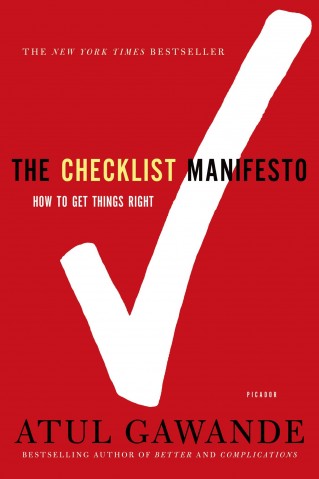
The Checklist Manifesto
By: Atul Gawande
Post 1
My fifth, and final book, has sadly arrived. By the time I finish reading this book, the end of our Literature Blog Project Reader's Workshop... thing... will arrive. I do not believe that I will plan on updating this blog nearly as frequently (though I may plan to start a separate blog, not focused on reading, later), but you are always welcome back to check for updates and such. And let's get down to the brass tacks...
So The Checklist Manifesto is written by Atul Gawande, who is both a writer and a surgeon. He starts off the book by talking about stories he had heard over time about medical emergencies whose most serious challenges could have been solved by being more observant, in other words, avoidable mistakes that were almost too costly. His experience as a surgeon, no doubt, will be a big contributor to the explanation of the checklist manifesto, as it is imperative that a doctor such as a surgeon be sure that all important procedures and steps are carried out.
I look forward to what kind of insights on checklists, organization, and the like are provided in this book. I'm not sure yet, but I am expecting a Malcolm Gladwell-like style in which the main idea of the book is laid out in sections each support by numerous studies, examples, etc.
Until next time,
Josh C.
By: Atul Gawande
Post 1
My fifth, and final book, has sadly arrived. By the time I finish reading this book, the end of our Literature Blog Project Reader's Workshop... thing... will arrive. I do not believe that I will plan on updating this blog nearly as frequently (though I may plan to start a separate blog, not focused on reading, later), but you are always welcome back to check for updates and such. And let's get down to the brass tacks...
So The Checklist Manifesto is written by Atul Gawande, who is both a writer and a surgeon. He starts off the book by talking about stories he had heard over time about medical emergencies whose most serious challenges could have been solved by being more observant, in other words, avoidable mistakes that were almost too costly. His experience as a surgeon, no doubt, will be a big contributor to the explanation of the checklist manifesto, as it is imperative that a doctor such as a surgeon be sure that all important procedures and steps are carried out.
I look forward to what kind of insights on checklists, organization, and the like are provided in this book. I'm not sure yet, but I am expecting a Malcolm Gladwell-like style in which the main idea of the book is laid out in sections each support by numerous studies, examples, etc.
Until next time,
Josh C.
Thursday, March 27, 2014
Life of Pi; Post 3
Life of Pi
By: Yann Martel
Post 3
Just like the movie, Life of Pi was truly something special. I had already seen the movie. I knew what to expect (The movie actually surprisingly true to the book, unlike some book-to-film adaptations). But I was still gripped by the plot, excited by Pi and Richard Parker's relationship, and satisfied by the ending all over again.
SPOILER ALERT
Since I last posted, all of the other animals on the life boat besides Richard Parker have died. The hyena was in fact killed by Richard Parker. As the days wore on, Pi made use of the lifeboat's supplies, including life vests and buoyant oars to make a raft so as to be separate from Richard Parker. He fished, witnessing many marine wonders, like whales, sharks, dorados (a type of fish which would turn rainbow and iridescent in its death throes), and flying fish. Gradually, as time wore on, and things like his life boat rations running out, his discovery of how to use solar stills to purify salt water, and the (eventual) destruction of his raft, Pi realizes that he must tame Richard Parker so that they can survive the ordeal (or at least so that Pi will be able to live on the life boat). Using the rocking of the boat, Richard Parker's seasickness, a whistle, and the supplying of food, Pi manages to tame Richard Parker, to an extent. Richard Parker recognizes him as the 'alpha' of the boat.
Two major events that Pi and Richard Parker experience are the meeting of another castaway and the discovery of an island. At one point in the story, Pi is overcome with the heat of the sun and fatigue, and becomes unable nourish himself, to the point where he becomes temporarily blinded. While blinded, he apparently meets another man (who has a French accent). They converse, and the other man claims to be blind as well. However, upon tethering their boats to each other, the other man, who is revealed to have lied about his blindness, attacks Pi, choking him. Pi, still delirious, accepts it as an embrace, and forgets to warn the man about Richard Parker. The man, who reveals his intentions to butcher and devour Pi for his own nourishment steps on the bottom of the boat and is subsequently devoured alive by Richard Parker. When Pi regains his eyesight after some brief nourishment through morsels of food that on the other man's boat and some rinsing with (sea)water, he finds the man's mangled half-eaten corpse. The other major event during Pi and Richard Parker's adventures include their landing on a strange isle. It is filled with vegetation and meerkats, and for the first time in a long time, Pi and Richard Parker are able to relax a little and enjoy the delicious algae and fresh water found on the isle. However, they discover later that the isle is more of a floating mass of carnivorous vegetation. At night, the ground and the freshwater ponds became highly acidic, digesting fish in the water and burning the soles of Pi's feet. Pi additionally found the remains of another human who must have stumbled upon the island: all that remained was a set of teeth. Pi and Richard Parker quickly left after that.
It was a short time later that they came upon land; the Mexican shores. Richard Parker flees into the forest, leaving Pi alone, even after all they'd been through together. Pi is rescued by a group of people who take him to the hospital, where he recovers. Two Japanese men from the company that the Tsimtsum sailed for come to interview Pi about the causes of the sinking of the ship, and what happened to him. They do not gain much information about the cause of the wreck, and initially they do not believe Pi's story with animals, so they request he tell the "truth." Pi responds with another story. This story metaphorically represents what happened, and also left out the seemingly supernatural events. The role of the zebra is replaced by a young sailor, the hyena by a vicious bloodthirsty cook, the orangutan by Pi's mother, and the tiger with Pi. The sailor's leg is broken, and after a prolonged period of time, he dies. The sailor is butchered, used for fishing, and eaten by the cook. Several days later, the cook attacks Pi for failing to catch a turtle, and Pi's mother hits the cook (the orangutan had originally fought back against the hyena by bopping it on the head). The cook turns on Pi's mother, who tells Pi to head towards a raft tied to the life boat. Pi's mother is then beheaded by the cook (the orangutan was beheaded by the hyena), who throws her head at Pi. Pi then kills the cook, just as Richard Parker killed the hyena. The Japanese men subsequently put the story with animals (the true story) on the official report.
So... a LOT happened in the second half of the book. More than can be merely summarized in a few short paragraphs.
I mentioned earlier that I thought religion would play a really big part in the book later... it didn't as much as I thought it would. It is touched upon a lot in the beginning, but the story ends up taking a much different focus by the end. I think probably the most interesting and prevalent dynamic and theme is the relationship between Pi and Richard Parker. At the beginning of their journey together, their relationship is rocky. But eventually, Pi gathers the courage to establish himself as 'alpha male' of the life boat, and Richard Parker (appears) to develop, at the very least, a grudging respect for him as leader. Their relationship continued to strengthen, even more so on the island, when Pi had Richard Parker perform tricks (jumping through a vine hoop), in an almost domesticated way. The real fascinating part was Richard Parker's ending of their partnership, by running off into the Mexican jungle without so much as a glance backwards. "In some such way, he would conclude our relationship. He did nothing of the sort... Then Richard Parker, companion of my torment, awful, fierce thing that kept me alive, moved forward and disappeared forever from my life" (Martel 284-285). I believe that though there was no physical indication, Richard Parker's decision to move on w a sign to Pi to not dwell on the past too much (but look to the future), and this advice was his farewell, conclusion, and goodbye.
Again, another great book has been completed. What book will come next?
Until next time,
Josh C.
By: Yann Martel
Post 3
Just like the movie, Life of Pi was truly something special. I had already seen the movie. I knew what to expect (The movie actually surprisingly true to the book, unlike some book-to-film adaptations). But I was still gripped by the plot, excited by Pi and Richard Parker's relationship, and satisfied by the ending all over again.
SPOILER ALERT
Since I last posted, all of the other animals on the life boat besides Richard Parker have died. The hyena was in fact killed by Richard Parker. As the days wore on, Pi made use of the lifeboat's supplies, including life vests and buoyant oars to make a raft so as to be separate from Richard Parker. He fished, witnessing many marine wonders, like whales, sharks, dorados (a type of fish which would turn rainbow and iridescent in its death throes), and flying fish. Gradually, as time wore on, and things like his life boat rations running out, his discovery of how to use solar stills to purify salt water, and the (eventual) destruction of his raft, Pi realizes that he must tame Richard Parker so that they can survive the ordeal (or at least so that Pi will be able to live on the life boat). Using the rocking of the boat, Richard Parker's seasickness, a whistle, and the supplying of food, Pi manages to tame Richard Parker, to an extent. Richard Parker recognizes him as the 'alpha' of the boat.
Two major events that Pi and Richard Parker experience are the meeting of another castaway and the discovery of an island. At one point in the story, Pi is overcome with the heat of the sun and fatigue, and becomes unable nourish himself, to the point where he becomes temporarily blinded. While blinded, he apparently meets another man (who has a French accent). They converse, and the other man claims to be blind as well. However, upon tethering their boats to each other, the other man, who is revealed to have lied about his blindness, attacks Pi, choking him. Pi, still delirious, accepts it as an embrace, and forgets to warn the man about Richard Parker. The man, who reveals his intentions to butcher and devour Pi for his own nourishment steps on the bottom of the boat and is subsequently devoured alive by Richard Parker. When Pi regains his eyesight after some brief nourishment through morsels of food that on the other man's boat and some rinsing with (sea)water, he finds the man's mangled half-eaten corpse. The other major event during Pi and Richard Parker's adventures include their landing on a strange isle. It is filled with vegetation and meerkats, and for the first time in a long time, Pi and Richard Parker are able to relax a little and enjoy the delicious algae and fresh water found on the isle. However, they discover later that the isle is more of a floating mass of carnivorous vegetation. At night, the ground and the freshwater ponds became highly acidic, digesting fish in the water and burning the soles of Pi's feet. Pi additionally found the remains of another human who must have stumbled upon the island: all that remained was a set of teeth. Pi and Richard Parker quickly left after that.
It was a short time later that they came upon land; the Mexican shores. Richard Parker flees into the forest, leaving Pi alone, even after all they'd been through together. Pi is rescued by a group of people who take him to the hospital, where he recovers. Two Japanese men from the company that the Tsimtsum sailed for come to interview Pi about the causes of the sinking of the ship, and what happened to him. They do not gain much information about the cause of the wreck, and initially they do not believe Pi's story with animals, so they request he tell the "truth." Pi responds with another story. This story metaphorically represents what happened, and also left out the seemingly supernatural events. The role of the zebra is replaced by a young sailor, the hyena by a vicious bloodthirsty cook, the orangutan by Pi's mother, and the tiger with Pi. The sailor's leg is broken, and after a prolonged period of time, he dies. The sailor is butchered, used for fishing, and eaten by the cook. Several days later, the cook attacks Pi for failing to catch a turtle, and Pi's mother hits the cook (the orangutan had originally fought back against the hyena by bopping it on the head). The cook turns on Pi's mother, who tells Pi to head towards a raft tied to the life boat. Pi's mother is then beheaded by the cook (the orangutan was beheaded by the hyena), who throws her head at Pi. Pi then kills the cook, just as Richard Parker killed the hyena. The Japanese men subsequently put the story with animals (the true story) on the official report.
So... a LOT happened in the second half of the book. More than can be merely summarized in a few short paragraphs.
I mentioned earlier that I thought religion would play a really big part in the book later... it didn't as much as I thought it would. It is touched upon a lot in the beginning, but the story ends up taking a much different focus by the end. I think probably the most interesting and prevalent dynamic and theme is the relationship between Pi and Richard Parker. At the beginning of their journey together, their relationship is rocky. But eventually, Pi gathers the courage to establish himself as 'alpha male' of the life boat, and Richard Parker (appears) to develop, at the very least, a grudging respect for him as leader. Their relationship continued to strengthen, even more so on the island, when Pi had Richard Parker perform tricks (jumping through a vine hoop), in an almost domesticated way. The real fascinating part was Richard Parker's ending of their partnership, by running off into the Mexican jungle without so much as a glance backwards. "In some such way, he would conclude our relationship. He did nothing of the sort... Then Richard Parker, companion of my torment, awful, fierce thing that kept me alive, moved forward and disappeared forever from my life" (Martel 284-285). I believe that though there was no physical indication, Richard Parker's decision to move on w a sign to Pi to not dwell on the past too much (but look to the future), and this advice was his farewell, conclusion, and goodbye.
Again, another great book has been completed. What book will come next?
Until next time,
Josh C.
Tuesday, March 25, 2014
Life of Pi; Post 2
Life of Pi
By: Yann Martel
Post 2
Hooray, I've reached a halfway point! Life of Pi is very entertaining. It keeps me enthralled, not so much with suspense, action, or adventure, but more the story premise itself.
SPOILER ALERT
A boy stranded on a lifeboat with a tiger, and a hyena, (and a now-deceased orangutan and zebra) in the middle of the Pacific Ocean. The whole concept is very interesting. So to recap, Pi's family has sold their zoo, and boarded a Japanese cargo ship (the Tsimtsum) headed for Canada. Pi has, since my last post, taken an interest in religion and the concept of God. He was born into the Hindu religion, but over the course of several chapters, also accepts and begins practicing Christianity and Islam. While his parents, brother, and various religious leaders are skeptical about his multiple faiths, Pi claims that he is merely trying to love God in as many ways as possible. So anyway, while on the Tsintsum in the middle of the Pacific Ocean, a massive storm hits and sinks the ship. The sole survivors are Pi, a zebra, an orangutan, a hyena, and a tiger named Richard Parker (The result of a mix up between the man who captured the tiger to send to the zoo's name, and the name the man gave the tiger). The zebra and orangutan have since been killed by the hyena, who is now being kept in check by the presence of Richard Parker.
A common theme that has been present in this book so far is the concept of religion, and God. Pi expresses his pleasure in being able to pursue multiple religions, and that his goal is "I just want to love God" (Martel 69). Additionally, earlier in the book (Author's Note), Martel is referred to Pi by a man, claiming Pi's story will "make you [Martel] believe in God" (Martel X). All of these religious elements in the early exposition of the beginning of the story set the stage for more themes about religion and God, which I do know are briefly touched upon in the movie.
As I mentioned in my last post, I do want to be pointing out the differences between the book and the movie, as I've seen so far. And so...
Plot elements included in the movie, but not the book:
- Pi attempts to feed Richard Parker, which causes Pi's father to show Ravi and Pi Richard Parker killing a goat (in the book, he shows it to them for no overt reason).
- Pi finds a girlfriend in the movie, but must leave her when he moves to Canada.
- Richard Parker immediately kills the hyena when the hyena kills the Orangutan (R.P. has not killed the hyena in the book yet)
Plot elements included in the book but not the movie:
- None so far
Until next time,
Josh C.
By: Yann Martel
Post 2
Hooray, I've reached a halfway point! Life of Pi is very entertaining. It keeps me enthralled, not so much with suspense, action, or adventure, but more the story premise itself.
SPOILER ALERT
A boy stranded on a lifeboat with a tiger, and a hyena, (and a now-deceased orangutan and zebra) in the middle of the Pacific Ocean. The whole concept is very interesting. So to recap, Pi's family has sold their zoo, and boarded a Japanese cargo ship (the Tsimtsum) headed for Canada. Pi has, since my last post, taken an interest in religion and the concept of God. He was born into the Hindu religion, but over the course of several chapters, also accepts and begins practicing Christianity and Islam. While his parents, brother, and various religious leaders are skeptical about his multiple faiths, Pi claims that he is merely trying to love God in as many ways as possible. So anyway, while on the Tsintsum in the middle of the Pacific Ocean, a massive storm hits and sinks the ship. The sole survivors are Pi, a zebra, an orangutan, a hyena, and a tiger named Richard Parker (The result of a mix up between the man who captured the tiger to send to the zoo's name, and the name the man gave the tiger). The zebra and orangutan have since been killed by the hyena, who is now being kept in check by the presence of Richard Parker.
A common theme that has been present in this book so far is the concept of religion, and God. Pi expresses his pleasure in being able to pursue multiple religions, and that his goal is "I just want to love God" (Martel 69). Additionally, earlier in the book (Author's Note), Martel is referred to Pi by a man, claiming Pi's story will "make you [Martel] believe in God" (Martel X). All of these religious elements in the early exposition of the beginning of the story set the stage for more themes about religion and God, which I do know are briefly touched upon in the movie.
As I mentioned in my last post, I do want to be pointing out the differences between the book and the movie, as I've seen so far. And so...
Plot elements included in the movie, but not the book:
- Pi attempts to feed Richard Parker, which causes Pi's father to show Ravi and Pi Richard Parker killing a goat (in the book, he shows it to them for no overt reason).
- Pi finds a girlfriend in the movie, but must leave her when he moves to Canada.
- Richard Parker immediately kills the hyena when the hyena kills the Orangutan (R.P. has not killed the hyena in the book yet)
Plot elements included in the book but not the movie:
- None so far
Until next time,
Josh C.
Monday, March 24, 2014
Life of Pi Movie Trailer
A very good movie that I would definitely recommend watching! Here's the trailer!

Life of Pi; Post 1
Life of Pi
By: Yann Martel
Post 1
I saw the movie adaptation of Life of Pi on DVD from the library last year, and it was very, very good. It was a really emotionally gripping, heartfelt story, with suspense and humor thrown into boot. So naturally, after seeing a good movie based on a book, I had to read the book.
Because I have seen the movie already, I already am relatively familiar with the story's general plot. So far, I have read through the first couple chapters, up to the part where Pi, the protagonist, begins his exploration of religion, starting with his acceptance of Christianity in addition to his current faith of Hinduism. He lives with his older brother, Ravi, and his parents, and together they run a zoo in an area known as Pondicherry. What's really interesting so far in the story, which was only mildly accommodated for in the movie, is that the story is told in first person from Pi's perspective, but there are occasional chapters in which the first person perspective switches to that of the author Yann Martel himself, who talks about meeting and talking with Pi in real life. Other than what little information is given about him in the story (that he was looking for a story when he was directed to Pi by Pi's uncle in India and that he is Canadian), I know almost nothing about Yann Martel. But after seeing the movie, I do not think it is as necessary for predictions as how the plot will unfold.
What I am interested in, however, is how the book will differ from the movie...
Until next time,
Josh C.
By: Yann Martel
Post 1
I saw the movie adaptation of Life of Pi on DVD from the library last year, and it was very, very good. It was a really emotionally gripping, heartfelt story, with suspense and humor thrown into boot. So naturally, after seeing a good movie based on a book, I had to read the book.
Because I have seen the movie already, I already am relatively familiar with the story's general plot. So far, I have read through the first couple chapters, up to the part where Pi, the protagonist, begins his exploration of religion, starting with his acceptance of Christianity in addition to his current faith of Hinduism. He lives with his older brother, Ravi, and his parents, and together they run a zoo in an area known as Pondicherry. What's really interesting so far in the story, which was only mildly accommodated for in the movie, is that the story is told in first person from Pi's perspective, but there are occasional chapters in which the first person perspective switches to that of the author Yann Martel himself, who talks about meeting and talking with Pi in real life. Other than what little information is given about him in the story (that he was looking for a story when he was directed to Pi by Pi's uncle in India and that he is Canadian), I know almost nothing about Yann Martel. But after seeing the movie, I do not think it is as necessary for predictions as how the plot will unfold.
What I am interested in, however, is how the book will differ from the movie...
Until next time,
Josh C.
Saturday, March 22, 2014
Lord of the Flies; Post 3
Lord of the Flies
By: William Golding
Post 3
And another book bites the dust. Lord of the Flies was quite an... interesting read. It was a quick, relatively light, and not too difficult read that I fairly enjoyed. The ending was a little bit strange, and may require some analytical "picking apart," so let's get down to business!
SPOILER ALERT
The aforementioned "beast" is both real, and not real. The original one, which was claimed to have been a monster, does not exist. However, a figure that two boys see on he mountain at night, a dead pilot (who had been parachuted down from an dogfight high above the island), is real, though the two boys over react and believe that he is the beast.
Meanwhile on the beach area, chaos reaches its tipping point. After several arguments between Jack and Ralph, Jack takes his hunters, and a most of the other boys, to a different side of he island. He encourages the chaos and savagery that fueled his own actions, which are contrary to Ralph's hope for order. The new tribe, led by Jack, kills a sow, and places its head on a stake, possibly symbolizing their savagery. A boy named Simon sees this head, and is assaulted by a hallucination, in which the pig head, also called the Lord of the Flies (for the large mass of flies that surrounded the pig head, which chases Simon after the hallucination), and "the beast," talks to him. Following this episode, Simon runs down towards where all the boys from both tribes have converged to feast, where he is brutally murdered by the other boys, showing what uncontrolled savagery can look like. The two tribes once again separate, and Jack's tribe steals Piggy's glasses, which had been used to create fires for the boys (bonfires, cook fires, signal fires, etc.). When Piggy, Ralph, and two other boys go to confront Jack, another boy rolls a rock down an incline, hitting and killing Piggy. The two other boys are captured and later join Jack's tribe, leaving Ralph all alone to be hunted by the group.
Ralph is eventually found, but before he can be killed, a British Naval Officer finds the boys, who all begin to cry as well. They cry at the loss of comrades, and for descending to such a level of savagery.
And that's how the book ends. A little strange, a little anti-climatic, but at the same time, very deep and thought provoking. After reading further into this book, I believe that Golding is trying to convey the idea that there is savagery in everyone. The pig's head hallucination lends some insight to this. It is a symbol of savagery, and at the same time, it is characterized as a real beast. Perhaps, Golding is attempting to convey the idea that the beast is not a physical monster, but a personal, demon, specifically one of savagery. Many of the boys release this demon and let it control their actions throughout the story, starting with Jack and his tribe. For example, their bloodlust drove them to create a rather morbid phrase to chant while killing pigs, or in the case of this quote, Simon. "Kill the beast! Cut his throat! Spill his blood! Do him in!" (Golding 154). I guess the final message is that savagery exists within all people, as Golding is implying.
Well, it was a really good read, and it was especially fascinating to see the boys descend into chaos. I can understand why this book is a classic. It tells a story that is fascinating, conveys a message of deep significance, and is easily understood by all ages (it's not a super difficult book).
You can look forward to more content coming up soon!
Until next time,
Josh C.
By: William Golding
Post 3
And another book bites the dust. Lord of the Flies was quite an... interesting read. It was a quick, relatively light, and not too difficult read that I fairly enjoyed. The ending was a little bit strange, and may require some analytical "picking apart," so let's get down to business!
SPOILER ALERT
The aforementioned "beast" is both real, and not real. The original one, which was claimed to have been a monster, does not exist. However, a figure that two boys see on he mountain at night, a dead pilot (who had been parachuted down from an dogfight high above the island), is real, though the two boys over react and believe that he is the beast.
Meanwhile on the beach area, chaos reaches its tipping point. After several arguments between Jack and Ralph, Jack takes his hunters, and a most of the other boys, to a different side of he island. He encourages the chaos and savagery that fueled his own actions, which are contrary to Ralph's hope for order. The new tribe, led by Jack, kills a sow, and places its head on a stake, possibly symbolizing their savagery. A boy named Simon sees this head, and is assaulted by a hallucination, in which the pig head, also called the Lord of the Flies (for the large mass of flies that surrounded the pig head, which chases Simon after the hallucination), and "the beast," talks to him. Following this episode, Simon runs down towards where all the boys from both tribes have converged to feast, where he is brutally murdered by the other boys, showing what uncontrolled savagery can look like. The two tribes once again separate, and Jack's tribe steals Piggy's glasses, which had been used to create fires for the boys (bonfires, cook fires, signal fires, etc.). When Piggy, Ralph, and two other boys go to confront Jack, another boy rolls a rock down an incline, hitting and killing Piggy. The two other boys are captured and later join Jack's tribe, leaving Ralph all alone to be hunted by the group.
Ralph is eventually found, but before he can be killed, a British Naval Officer finds the boys, who all begin to cry as well. They cry at the loss of comrades, and for descending to such a level of savagery.
And that's how the book ends. A little strange, a little anti-climatic, but at the same time, very deep and thought provoking. After reading further into this book, I believe that Golding is trying to convey the idea that there is savagery in everyone. The pig's head hallucination lends some insight to this. It is a symbol of savagery, and at the same time, it is characterized as a real beast. Perhaps, Golding is attempting to convey the idea that the beast is not a physical monster, but a personal, demon, specifically one of savagery. Many of the boys release this demon and let it control their actions throughout the story, starting with Jack and his tribe. For example, their bloodlust drove them to create a rather morbid phrase to chant while killing pigs, or in the case of this quote, Simon. "Kill the beast! Cut his throat! Spill his blood! Do him in!" (Golding 154). I guess the final message is that savagery exists within all people, as Golding is implying.
Well, it was a really good read, and it was especially fascinating to see the boys descend into chaos. I can understand why this book is a classic. It tells a story that is fascinating, conveys a message of deep significance, and is easily understood by all ages (it's not a super difficult book).
You can look forward to more content coming up soon!
Until next time,
Josh C.
Thursday, March 20, 2014
Lord of the Flies; Post 2
Lord of the Flies
By: William Golding
Post 2
Lord of the Flies has been a nice break from some of the thicker (Ender's Game) and drier (The Tipping Point) that I've read so far. It's a nice balance between an interesting plot and a story that seems too simple to not have an underlying message of some kind.
SPOILER ALERT
So this far into the story, chaos is just beginning to erupt. Amongst all the boys, there are several tasks that are recur as points of conflict. There is the signal fire on top of the mountain on the island, that the boys plan to keep lit to attract ships in the event that they will be able to be rescued. There is also a group of boys who act as hunters; they attempt to hunt meat for the boys by killing wild pigs that inhabit the island. The boys seem to have been divided over which tasks are the most important. A boy named Ralph, named chief by the majority of the boys, believes that survival and being rescued is of the utmost importance. Another boy, Jack, believes that hunting the pigs is the most important focus, and as a result, he let the fire go out, right as Ralph saw a ship pass the island in the distance. Obviously, this is one of the biggest focal points of tension between the two groups of boys (survivors vs. hunters). To even further the conflict, there is disagreement between the older and younger boys about the existence of a "beast" of some kind on the island.
I think that Golding is trying to convey some kind of message about disorder in society. The way in which he characterizes the boys, such as Ralph and Jack, and their arguments, is worded in such a way that it even riles me up, as a reader. I felt sympathy for a bullied character, Piggy, and I felt aggression towards Jack for letting the fire go out and missing the chance to signal the ship. Perhaps Golding is trying to aggravate the reader in order to express what chaos and disorder is. "This far from civilization they can do anything they want. Anything. But as order collapses, as strange howls echo in the night, as terror begins its reign..." (Golding Back Cover Summary).
Anyway, I look forward to seeing how this book ends!
Until next time,
Josh C.
By: William Golding
Post 2
Lord of the Flies has been a nice break from some of the thicker (Ender's Game) and drier (The Tipping Point) that I've read so far. It's a nice balance between an interesting plot and a story that seems too simple to not have an underlying message of some kind.
SPOILER ALERT
So this far into the story, chaos is just beginning to erupt. Amongst all the boys, there are several tasks that are recur as points of conflict. There is the signal fire on top of the mountain on the island, that the boys plan to keep lit to attract ships in the event that they will be able to be rescued. There is also a group of boys who act as hunters; they attempt to hunt meat for the boys by killing wild pigs that inhabit the island. The boys seem to have been divided over which tasks are the most important. A boy named Ralph, named chief by the majority of the boys, believes that survival and being rescued is of the utmost importance. Another boy, Jack, believes that hunting the pigs is the most important focus, and as a result, he let the fire go out, right as Ralph saw a ship pass the island in the distance. Obviously, this is one of the biggest focal points of tension between the two groups of boys (survivors vs. hunters). To even further the conflict, there is disagreement between the older and younger boys about the existence of a "beast" of some kind on the island.
I think that Golding is trying to convey some kind of message about disorder in society. The way in which he characterizes the boys, such as Ralph and Jack, and their arguments, is worded in such a way that it even riles me up, as a reader. I felt sympathy for a bullied character, Piggy, and I felt aggression towards Jack for letting the fire go out and missing the chance to signal the ship. Perhaps Golding is trying to aggravate the reader in order to express what chaos and disorder is. "This far from civilization they can do anything they want. Anything. But as order collapses, as strange howls echo in the night, as terror begins its reign..." (Golding Back Cover Summary).
Anyway, I look forward to seeing how this book ends!
Until next time,
Josh C.
Wednesday, March 19, 2014

Lord of the Flies; Post 1
Lord of the Flies
By: William Golding
Post 1
Next on the list of books is a real classic, Lord of the Flies. I've finally found a "classic" book that has grabbed my attention from the beginning, and it's pretty interesting so far. It's about a group of school boys who are been stranded on an uninhabited, tropical island in a plane wreck. It is implied that the plane was shot down during some type of war period. Already, the boys have made attempts to create an organized system of leadership, but it is beginning to crumble as the days wear on. I can only predict that the group will continue to devolve into chaos as isolation, fear, and the struggles of survival in the wild become more relevant.
I do not know much about William Golding, except that he served in the military during World War II, and landed in Normandy during D-Day, prior to the writing of Lord of the Flies. With this, perhaps I can expect to see some form of militarism or military-esque qualities to the boys' methods of organization. This feels likes its going to be an exciting read, and I can't wait to continue!
Until next time,
Josh C.
By: William Golding
Post 1
Next on the list of books is a real classic, Lord of the Flies. I've finally found a "classic" book that has grabbed my attention from the beginning, and it's pretty interesting so far. It's about a group of school boys who are been stranded on an uninhabited, tropical island in a plane wreck. It is implied that the plane was shot down during some type of war period. Already, the boys have made attempts to create an organized system of leadership, but it is beginning to crumble as the days wear on. I can only predict that the group will continue to devolve into chaos as isolation, fear, and the struggles of survival in the wild become more relevant.
I do not know much about William Golding, except that he served in the military during World War II, and landed in Normandy during D-Day, prior to the writing of Lord of the Flies. With this, perhaps I can expect to see some form of militarism or military-esque qualities to the boys' methods of organization. This feels likes its going to be an exciting read, and I can't wait to continue!
Until next time,
Josh C.
Sunday, March 16, 2014
The Tipping Point; Post 3
The Tipping Point
By: Malcolm Gladwell
Post 3
So, I've finished The Tipping Point. It was quite enjoyable. The remaining two categories, or causes, of epidemics that the books lays out are the "Stickiness Factor," and the power what environment in which the epidemic begins. Overall, the book has been a very interesting read, albeit a sluggish one. The ideas laid out in the book were very in-depth and analytical, and they really piqued my interest, but it was tough to read analysis after analysis for hours on end. That's one of the reasons it took me so long to put out these past few posts. But anyway...
The "Stickiness Factor," as Gladwell calls it, is essentially what makes ideas that are the focus of various epidemics so popular, what makes them remembered, what makes them "sticky." Examples he gave of "sticky" trending ideas were the TV shows Sesame Street and Blues Clues. They captivated toddler audiences after multiple trial and error experiments to find what made TV shows for kids "sticky." The results were that the shows were unlike any other of the time. Blues Clues, for instance, aired the same episode multiple times in a week and encouraged audience involvement, which was unheard of at the time, but made the show incredibly popular. Sesame Street blurred the lines between fantasy and reality (putting Muppets on the same stage as human actors), and was successful enough to consistently improve the literacy rate of viewers. All these tactics made these shows unique and "sticky" to the intended audience(s), resulting their rise and popularity and classification as a trend/epidemic.
The power of the environment the epidemic thrives in is described in the chapters: "The Power of Context (Part One and Two)." One example illustrates how the physical environment, such as a city, affects epidemics. The crime rate in New York dropped drastically, likely due to the massive effort that was put into renovating, cleaning, and improving of the subway system. Graffiti was erased, subway trains were maintained and vandalized ones were never allowed to run; the subway police knuckled down on "turnstile-jumping" (a crime in which people would skip subway fares and jump over the turnstiles, hence then name). By creating a different environment, in which crime would not thrive, an epidemic was able to occur. The rapid 1990's New York crime rate decline. Another example of environmental effects on epidemics involved the actions of others around trend starters. Such as in Micronesia, where adolescent suicide became a trend. One boy's death caused many others to follow suit, even if for seemingly trivial reasons, or because they want to "experiment" with suicide, the way teenagers may "experiment" with drugs and alcohol. (Note: This example of the usage of the Power of Context is from one of the Case Study chapters)
There were additional chapters, titled "Case Study" which gave examples of all three elements of epidemics; you got to see his theories/opinions/ideas/concepts in action.
Gladwell most definitely has ideas for thought in this book. He provided many, many, MANY, examples, ideas, analyses, opinions, and insights on the causes of epidemics. Just looking aback on the whole book and thinking about them: "The Law of Few (Gladwell Chap 1)", which laid out what kind of people start and spread epidemics; "The Stickiness Factor (Gladwell Chap 2)", which explained what kind of elements made a trend stick and become popular; and "The Power of Context Parts One and Two" (Gladwell Chap 4 and 5), which told how environments can affect epidemics.
On a personal note, I too have seen epidemics of a similar nature, with elements similar to such as those that Gladwell describes. There was a computer game that was growing in popularity. I, personally, had heard of it, but never thought to ever play it. I had heard about it through many friends who acted as Salesmen, who also played it (environmental influence on me), and eventually, after watching it become popularized by Mavens on YouTube, I gave it a try. And, it worked, and I became part of this very fun, addicting, "sticky" trend, that is continuing to grow fast. As of this past February, this game, the PC game Minecraft, has sold over 14 million copies on PC/Mac/Linux, and over 35 million copies across Computers, Xbox, and Mobile platforms.
I think the real thing that amazed me about this book is how applicable it is, and how the logic to his arguments and the examples he uses to support them, all make so much sense. It can even be seen applied in our own lives. Overall, while it may have dried up at times (analysis, while interesting, is no easy thing to read for hours on end), The Tipping Point has been a great book!
Until next time,
Josh C.
By: Malcolm Gladwell
Post 3
So, I've finished The Tipping Point. It was quite enjoyable. The remaining two categories, or causes, of epidemics that the books lays out are the "Stickiness Factor," and the power what environment in which the epidemic begins. Overall, the book has been a very interesting read, albeit a sluggish one. The ideas laid out in the book were very in-depth and analytical, and they really piqued my interest, but it was tough to read analysis after analysis for hours on end. That's one of the reasons it took me so long to put out these past few posts. But anyway...
The "Stickiness Factor," as Gladwell calls it, is essentially what makes ideas that are the focus of various epidemics so popular, what makes them remembered, what makes them "sticky." Examples he gave of "sticky" trending ideas were the TV shows Sesame Street and Blues Clues. They captivated toddler audiences after multiple trial and error experiments to find what made TV shows for kids "sticky." The results were that the shows were unlike any other of the time. Blues Clues, for instance, aired the same episode multiple times in a week and encouraged audience involvement, which was unheard of at the time, but made the show incredibly popular. Sesame Street blurred the lines between fantasy and reality (putting Muppets on the same stage as human actors), and was successful enough to consistently improve the literacy rate of viewers. All these tactics made these shows unique and "sticky" to the intended audience(s), resulting their rise and popularity and classification as a trend/epidemic.
The power of the environment the epidemic thrives in is described in the chapters: "The Power of Context (Part One and Two)." One example illustrates how the physical environment, such as a city, affects epidemics. The crime rate in New York dropped drastically, likely due to the massive effort that was put into renovating, cleaning, and improving of the subway system. Graffiti was erased, subway trains were maintained and vandalized ones were never allowed to run; the subway police knuckled down on "turnstile-jumping" (a crime in which people would skip subway fares and jump over the turnstiles, hence then name). By creating a different environment, in which crime would not thrive, an epidemic was able to occur. The rapid 1990's New York crime rate decline. Another example of environmental effects on epidemics involved the actions of others around trend starters. Such as in Micronesia, where adolescent suicide became a trend. One boy's death caused many others to follow suit, even if for seemingly trivial reasons, or because they want to "experiment" with suicide, the way teenagers may "experiment" with drugs and alcohol. (Note: This example of the usage of the Power of Context is from one of the Case Study chapters)
There were additional chapters, titled "Case Study" which gave examples of all three elements of epidemics; you got to see his theories/opinions/ideas/concepts in action.
Gladwell most definitely has ideas for thought in this book. He provided many, many, MANY, examples, ideas, analyses, opinions, and insights on the causes of epidemics. Just looking aback on the whole book and thinking about them: "The Law of Few (Gladwell Chap 1)", which laid out what kind of people start and spread epidemics; "The Stickiness Factor (Gladwell Chap 2)", which explained what kind of elements made a trend stick and become popular; and "The Power of Context Parts One and Two" (Gladwell Chap 4 and 5), which told how environments can affect epidemics.
On a personal note, I too have seen epidemics of a similar nature, with elements similar to such as those that Gladwell describes. There was a computer game that was growing in popularity. I, personally, had heard of it, but never thought to ever play it. I had heard about it through many friends who acted as Salesmen, who also played it (environmental influence on me), and eventually, after watching it become popularized by Mavens on YouTube, I gave it a try. And, it worked, and I became part of this very fun, addicting, "sticky" trend, that is continuing to grow fast. As of this past February, this game, the PC game Minecraft, has sold over 14 million copies on PC/Mac/Linux, and over 35 million copies across Computers, Xbox, and Mobile platforms.
I think the real thing that amazed me about this book is how applicable it is, and how the logic to his arguments and the examples he uses to support them, all make so much sense. It can even be seen applied in our own lives. Overall, while it may have dried up at times (analysis, while interesting, is no easy thing to read for hours on end), The Tipping Point has been a great book!
Until next time,
Josh C.
Saturday, March 15, 2014
The Tipping Point; Post 2
The Tipping Point
By: Malcolm Gladwell
Post 2
My apologies... I haven't posted anything new in quite some time. I've been caught up in reading. I actually just finished The Tipping Point, and upon doing so, realized I had neither completed nor had I posted my second post for this book! I started it a while a go (and therefore it is written in the context of only having been halfway through at the time), but never finished it before I continued reading. Here it is! Expect the third and final post within a day or so!
The Tipping Point is going well so far. I've read just under half the book, and wanted to put out some fresh content! As far as I've read, epidemics or trends, however you wish to phrase them, are often set into motion or popularized by certain types of people. There are "Connectors," who know a lot of people, and are very socially connected. They create word-of-mouth epidemics, or epidemics that are spread verbally. They will usually be based upon the experience or hearings of the connector. There are also "Mavens." They are the well-informed trend starters. They know which products to choose and avoid, what locations to travel to, and why. They are continually absorbing information to add to their database of knowledge. These well-informed Mavens, as described by Gladwell, often feel the need to be helpful to others by sharing their information with others. This information can be passed by word-of-mouth, passing through everyday people, and connectors as well. Finally, there are "Salesmen." These are the charismatic, and persuasive group of people, who influence the passing of trends. Studies described by Gladwell show how in charismatic people like Salesmen, even a small gesture, like a smile, can affect the decisions people make, passing along trends and continuing epidemics in this manner.
If you've been having trouble understanding, don't worry, I had a little trouble understanding the concept the first time I read through it. The concept of these three people is probably more easily understood through examples. Paul Revere, famous for his late-night ride to warn the colonial militias of the coming British advance on Lexington and Concord, was both a Connector and a Maven. He was well-known by many, knew who to alert as he passed through each town (other Connectors and militia leaders), and was able to spread the word very efficiently. He also was an active participant in a colonial intelligence-gathering group, who spied on British movements, and therefore a Maven, spreading his knowledge for the benefit of others. An example of a Salesman would be Peter Jennings of ABC, especially during the 1984 presidential campaign. He, subliminally, and seemingly unconsciously, swayed the audience in the general favor of Ronald Reagan. It was not through the content that he broadcasted however, that he swayed audiences, but because of his varying facial expressions, which, however subtly, had been biased towards Reagan.
Overall, I have found his opinions to be fairly compelling. He provides a lot of data and statistics from various experiments, examples and studies to support the concepts of these types of people. For example, right off the bat in the first couple chapters, Gladwell uses the example of the New York Crime epidemic to illustrate what kind of epidemics he plans to discuss throughout the book. He uses statistics to show how significant epidemics can be, and also to hook the reader in, "In 1992, there were 2,1154 murders in New York City, and 626,182 serious rimes... At some mysterious and critical point, the crime rate began to turn. It tipped. Within five years, mruders dropped 64.3 percent to 770 and total crimes had fallen by almost half to 255,893" (Gladwell 5 and 6). I expect to see even more examples of such experiments as I move further into the book. In all honesty, this constant use of examples to both support his opinions and to keep readers, like me, interested is a very good strategy for the expression of his ideas. I find it very hard to disagree with anything he says.
I'm looking forward towards the end of the book, to see what other elements of trends and epidemics make them so interesting, popular, and "sticky."
Until next time,
Josh C.
By: Malcolm Gladwell
Post 2
My apologies... I haven't posted anything new in quite some time. I've been caught up in reading. I actually just finished The Tipping Point, and upon doing so, realized I had neither completed nor had I posted my second post for this book! I started it a while a go (and therefore it is written in the context of only having been halfway through at the time), but never finished it before I continued reading. Here it is! Expect the third and final post within a day or so!
The Tipping Point is going well so far. I've read just under half the book, and wanted to put out some fresh content! As far as I've read, epidemics or trends, however you wish to phrase them, are often set into motion or popularized by certain types of people. There are "Connectors," who know a lot of people, and are very socially connected. They create word-of-mouth epidemics, or epidemics that are spread verbally. They will usually be based upon the experience or hearings of the connector. There are also "Mavens." They are the well-informed trend starters. They know which products to choose and avoid, what locations to travel to, and why. They are continually absorbing information to add to their database of knowledge. These well-informed Mavens, as described by Gladwell, often feel the need to be helpful to others by sharing their information with others. This information can be passed by word-of-mouth, passing through everyday people, and connectors as well. Finally, there are "Salesmen." These are the charismatic, and persuasive group of people, who influence the passing of trends. Studies described by Gladwell show how in charismatic people like Salesmen, even a small gesture, like a smile, can affect the decisions people make, passing along trends and continuing epidemics in this manner.
If you've been having trouble understanding, don't worry, I had a little trouble understanding the concept the first time I read through it. The concept of these three people is probably more easily understood through examples. Paul Revere, famous for his late-night ride to warn the colonial militias of the coming British advance on Lexington and Concord, was both a Connector and a Maven. He was well-known by many, knew who to alert as he passed through each town (other Connectors and militia leaders), and was able to spread the word very efficiently. He also was an active participant in a colonial intelligence-gathering group, who spied on British movements, and therefore a Maven, spreading his knowledge for the benefit of others. An example of a Salesman would be Peter Jennings of ABC, especially during the 1984 presidential campaign. He, subliminally, and seemingly unconsciously, swayed the audience in the general favor of Ronald Reagan. It was not through the content that he broadcasted however, that he swayed audiences, but because of his varying facial expressions, which, however subtly, had been biased towards Reagan.
Overall, I have found his opinions to be fairly compelling. He provides a lot of data and statistics from various experiments, examples and studies to support the concepts of these types of people. For example, right off the bat in the first couple chapters, Gladwell uses the example of the New York Crime epidemic to illustrate what kind of epidemics he plans to discuss throughout the book. He uses statistics to show how significant epidemics can be, and also to hook the reader in, "In 1992, there were 2,1154 murders in New York City, and 626,182 serious rimes... At some mysterious and critical point, the crime rate began to turn. It tipped. Within five years, mruders dropped 64.3 percent to 770 and total crimes had fallen by almost half to 255,893" (Gladwell 5 and 6). I expect to see even more examples of such experiments as I move further into the book. In all honesty, this constant use of examples to both support his opinions and to keep readers, like me, interested is a very good strategy for the expression of his ideas. I find it very hard to disagree with anything he says.
I'm looking forward towards the end of the book, to see what other elements of trends and epidemics make them so interesting, popular, and "sticky."
Until next time,
Josh C.
Wednesday, March 12, 2014
Sunday, March 9, 2014
The Tipping Point; Post 1
The Tipping Point
By: Malcolm Gladwell
Post 1
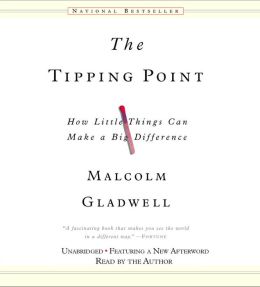
The Tipping Point. An interesting title. Recommended to me by my parents, this has proven to be quiet an interesting read so far. It is an analytical non-fiction book about how and why trends, epidemics, and the like are caused. It addresses questions like "Who starts trends?" "How do such trends spread quickly?" and "What is the tipping point that causes such trends to become so large?" So far into the book, (only through the Introduction), Gladwell talks about several epidemics and trends, like the rapidly fluctuating New York City crime rate in the mid 90's, the spread of the HIV virus, and the resurgence of the popularity of Hush Puppies (shoes). I don't know much about Malcolm Gladwell, except that he has written two New York Times' Bestsellers (The Tipping Point, and Blink, which was another book my parents recommended). That means I can look forward to thoughtful and well-written analyses about these rise and falls of trends. Overall, this books looks like it's going to be very interesting, and I'm eager to continue reading!
Until next time,
Josh C.
By: Malcolm Gladwell
Post 1
The Tipping Point. An interesting title. Recommended to me by my parents, this has proven to be quiet an interesting read so far. It is an analytical non-fiction book about how and why trends, epidemics, and the like are caused. It addresses questions like "Who starts trends?" "How do such trends spread quickly?" and "What is the tipping point that causes such trends to become so large?" So far into the book, (only through the Introduction), Gladwell talks about several epidemics and trends, like the rapidly fluctuating New York City crime rate in the mid 90's, the spread of the HIV virus, and the resurgence of the popularity of Hush Puppies (shoes). I don't know much about Malcolm Gladwell, except that he has written two New York Times' Bestsellers (The Tipping Point, and Blink, which was another book my parents recommended). That means I can look forward to thoughtful and well-written analyses about these rise and falls of trends. Overall, this books looks like it's going to be very interesting, and I'm eager to continue reading!
Until next time,
Josh C.
Ender's Game; Post 3
Ender's Game
By: Orson Scott Card
Post 3
DEFINITE SPOILER ALERT
As I approached the final quarter or so of the book, the plot grew ever more intense. Ender is advancing through the ranks quicker than anyone had ever done so previously. He is introduced to the Command School, in which he is taught how to command a fleet, as is expected of him. It also revealed that Ender will be commanding the Earth that is poised to attack, invade, and/or destroy the "Bugger" home worlds. There are also several plot twists that made the ending very surprising. Even though I've flagged this as a spoiler, I'm not evil enough to completely give away the ending.
Anyway, I really enjoyed the book! It was a great read, full of action and suspense, with mysterious and/or darker underlying themes of manipulation and war. If there is one more analysis-type statement I would want to make about the book, it is about the significance of the mind games used throughout the story, especially the ones played on Ender, whether by teachers or other elders of significance, or an AI computer. I talked earlier about the manipulation of Ender, and this is just part of the bigger picture. The full severity of the computer mind game Ender experiences, known as "Free Play," is revealed when disturbing scenes from the game are implied to have existed in actuality on a distant planet. Again, to preserve the ending as much as possible while still analyzing the story as a whole, I will not reveal what scenes nor what planet, but needless to say, it contributed to the overall surprise of the story. "Now Ender knew why it looked familiar... He had played here too many times as a child not to know this place. But it was not possible. The computer in the Battle School could not have possible seen this place. He looked through his binoculars in a direction he knew well, fearing and hoping that he would see what belonged in that place... Now overgrown, but their shapes still unmistakable," (Card 317). Now at this point in your reading of this post, you may be wondering what the significance of these mind games in the book are. It's because I believe the mind games are a reference to the (seemingly) odd title. Ender's Game, his game. All these mind games that toyed with him and manipulated him throughout the story, throughout his life, become so much more significant when he finds them represented in the real world, signifying that, in a way, his life has been controlled a "game," his game.
Well that brings me to the end of this brief post series on Ender's Game, by Orson Scott Card. It was a great read, and I now can look forward to seeing the movie as well! Thank you for taking the time to read my summaries and analyses, I hop you found them useful, interesting, or at least somewhat entertaining!
Until next time,
Josh C.
Coming up Next: The Tipping Point, by: Malcom Gladwell
By: Orson Scott Card
Post 3
DEFINITE SPOILER ALERT
As I approached the final quarter or so of the book, the plot grew ever more intense. Ender is advancing through the ranks quicker than anyone had ever done so previously. He is introduced to the Command School, in which he is taught how to command a fleet, as is expected of him. It also revealed that Ender will be commanding the Earth that is poised to attack, invade, and/or destroy the "Bugger" home worlds. There are also several plot twists that made the ending very surprising. Even though I've flagged this as a spoiler, I'm not evil enough to completely give away the ending.
Anyway, I really enjoyed the book! It was a great read, full of action and suspense, with mysterious and/or darker underlying themes of manipulation and war. If there is one more analysis-type statement I would want to make about the book, it is about the significance of the mind games used throughout the story, especially the ones played on Ender, whether by teachers or other elders of significance, or an AI computer. I talked earlier about the manipulation of Ender, and this is just part of the bigger picture. The full severity of the computer mind game Ender experiences, known as "Free Play," is revealed when disturbing scenes from the game are implied to have existed in actuality on a distant planet. Again, to preserve the ending as much as possible while still analyzing the story as a whole, I will not reveal what scenes nor what planet, but needless to say, it contributed to the overall surprise of the story. "Now Ender knew why it looked familiar... He had played here too many times as a child not to know this place. But it was not possible. The computer in the Battle School could not have possible seen this place. He looked through his binoculars in a direction he knew well, fearing and hoping that he would see what belonged in that place... Now overgrown, but their shapes still unmistakable," (Card 317). Now at this point in your reading of this post, you may be wondering what the significance of these mind games in the book are. It's because I believe the mind games are a reference to the (seemingly) odd title. Ender's Game, his game. All these mind games that toyed with him and manipulated him throughout the story, throughout his life, become so much more significant when he finds them represented in the real world, signifying that, in a way, his life has been controlled a "game," his game.
Well that brings me to the end of this brief post series on Ender's Game, by Orson Scott Card. It was a great read, and I now can look forward to seeing the movie as well! Thank you for taking the time to read my summaries and analyses, I hop you found them useful, interesting, or at least somewhat entertaining!
Until next time,
Josh C.
Coming up Next: The Tipping Point, by: Malcom Gladwell
Wednesday, March 5, 2014
Ender's Game; Post 2
Ender's Game
By: Orson Scott Card
Post 2
So I've made it part way through the book, and I am really enjoying it so far. The concepts of the futuristic Earth are enthralling, and the character development Ender has been going through has continually intrigued me, as his entire perspective and mindset evolves with each change to the environment he finds himself in.
SPOILER ALERT: (I will be posting summaries and descriptions of book plots, and I will do my best to alert you readers and viewers when I will be revealing crucial plot details).
To give a brief background, Earth has been attacked by aliens, known as "Buggers." The humans were able to prevail and repel the first two invasions of the aliens, and, anticipating more attacks in the future, began recruiting, or even, breeding, human children to become brilliant and innovative soldiers and commanders. Ender is one such child, who is accepted into Earth's Battle School, in which he will learn about space combat and strategy in war-simulation games, in addition to his normal school subjects. He quickly excels, and progresses his way through the ranks until he becomes the commander of his own team, or army.
Throughout the story, I have noticed that a re-occurring theme is manipulation, especially psychological manipulation. Ender comments on how tactically and manipulatively, his mind is toyed with by the Battle School administration. He comes to this realization shortly after being assigned to lead a team of young, inexperienced, unfamiliar recruits. "It was the teachers who had done it. And it wasn't an accident. Ender realized that now. It was a strategy. Graff had deliberately set him up to be separate from the other boys, made it impossible for him to be close to them. And he began now to suspect the reasons behind it... Graff had isolated Ender to make him struggle. To make him prove, not that he was competent, but that he was far better than everyone else. That was the only way he could win respect and friendship. It made him a better soldier... It also made him lonely, afraid, angry, untrusting. And maybe those traits, too, made him a better soldier" (Card 167, 168). Looking ahead, I think that this manipulation and the way that Ender will respond to it will culminate in situation in which Ender finally is free of manipulation, and will be controlling his actions for himself, hence the title "Ender's Game." After being manipulated by games for the majority of his life, he would finally be able to "call the shots."
Overall, I think that I will definitely see this book through to the end. I find it captivating, with enough action to keep me enthralled and enough symbolic and underlying messages to stimulate my mind as I read. It's also fairly complex, to an extent, which keeps it interesting. The first story arc in which Ender has been living at the Battle School, and it climaxes as he and his team win victory after victory. A different arc appears as Ender is graduated from Battle School early and put into Command School (School specializing in the training of commanders). This arc I am only just beginning to get introduced to, and I am excited as ever.
Well, that's it for this post. The third and final post about Ender's Game and its conclusion will be coming soon!
Until next time,
Josh C.
Tuesday, March 4, 2014

Ender's Game; Post 1
Ender's Game
By: Orson Scott Card
Post 1
Until I started reading this, book, I had little to no prior knowledge of the premise, the author, or the context in which it was written. All that I knew was that it was a successful book that had been turned into a movie in 2013, and that it was a science fiction novel. I actually believe that this is one of the things that drew me to it, the fact that I knew very little about it, except that it was considered to be a "good" book by many. My curiosity is what drew me in. I enjoy the science fiction genre in general, so that was an additional motive for picking up this book. Upon starting the book, I did a little background research on the author, Orson Scott Card. He lives/has lived in the south western United States (Arizona, California, and Utah), and, religiously, is of a Mormon background. He also has worked as a playwright, computer game reviewer, and a magazine columnist (The Magazing of Fantasy and Science Fiction). Based on this new found knowledge, I can guess that his work with computer/video games influence or was influence by his writing of Ender's Game, and that in a similar fashion, his Mormon beliefs or values may be expressed, alluded to, or even overtly stated throughout the story. Only reading through it will tell. I'm really excited to see where this book will go, though. From preliminary readings within the first few chapters, it seems to be set in a future Earth, which has developed strange technology and customs as a result of an inter-planetary/extra-terrestrial/super-natural war. I can very easily predict that the main character, Ender, will see battle sometime in the book. However, how and when he gets into battle is what intrigues me. He is six years old in the first few chapters, so perhaps he is sent to military school, or is trained under a mysterious mentor until he can/will see combat. The possibilities are pretty open considering that it is of the Science Fiction genre.
I have been told that this book is very good, so I am eager to dive into it.
Until next time,
Josh C.
By: Orson Scott Card
Post 1
Until I started reading this, book, I had little to no prior knowledge of the premise, the author, or the context in which it was written. All that I knew was that it was a successful book that had been turned into a movie in 2013, and that it was a science fiction novel. I actually believe that this is one of the things that drew me to it, the fact that I knew very little about it, except that it was considered to be a "good" book by many. My curiosity is what drew me in. I enjoy the science fiction genre in general, so that was an additional motive for picking up this book. Upon starting the book, I did a little background research on the author, Orson Scott Card. He lives/has lived in the south western United States (Arizona, California, and Utah), and, religiously, is of a Mormon background. He also has worked as a playwright, computer game reviewer, and a magazine columnist (The Magazing of Fantasy and Science Fiction). Based on this new found knowledge, I can guess that his work with computer/video games influence or was influence by his writing of Ender's Game, and that in a similar fashion, his Mormon beliefs or values may be expressed, alluded to, or even overtly stated throughout the story. Only reading through it will tell. I'm really excited to see where this book will go, though. From preliminary readings within the first few chapters, it seems to be set in a future Earth, which has developed strange technology and customs as a result of an inter-planetary/extra-terrestrial/super-natural war. I can very easily predict that the main character, Ender, will see battle sometime in the book. However, how and when he gets into battle is what intrigues me. He is six years old in the first few chapters, so perhaps he is sent to military school, or is trained under a mysterious mentor until he can/will see combat. The possibilities are pretty open considering that it is of the Science Fiction genre.
I have been told that this book is very good, so I am eager to dive into it.
Until next time,
Josh C.
Saturday, March 1, 2014
Welcome!
Hello! Welcome to Jot it Down with Josh: A Book Blog!
For my high school Gifted Lit. Class, my class will be doing a Reader's Workshop, and the assignment is to read.... and blog about it! On this blog, you can expect, in the future, to see a number of reviews, analyses, comments, synopses, and opinions on a number of books that I read for this project! I hope to hear from my fellow classmates as they too blog, and as we are all required to comment on each others' blogs! I hope you all enjoy!
Expect the first few posts within the next couple of days!
Until next time,
Josh C.
First on my personal agenda of books to read:
Ender's Game by: Orson Scott Card
For my high school Gifted Lit. Class, my class will be doing a Reader's Workshop, and the assignment is to read.... and blog about it! On this blog, you can expect, in the future, to see a number of reviews, analyses, comments, synopses, and opinions on a number of books that I read for this project! I hope to hear from my fellow classmates as they too blog, and as we are all required to comment on each others' blogs! I hope you all enjoy!
Expect the first few posts within the next couple of days!
Until next time,
Josh C.
First on my personal agenda of books to read:
Ender's Game by: Orson Scott Card
Subscribe to:
Comments (Atom)