Well, it's been a fun ride. The Reading workshop for our class is coming to a close, and I will no longer be required to maintain a blog such as this. I've really enjoyed doing this, and perhaps in the future, I'll expand and explore the other aspects of blogging, besides literary reviews and analysis. If I do create such a blog, then I will most definitely be posting a link here. Thanks for visiting Jot it Down with Josh!
- Josh
P.S. Posts on this blog will become much more infrequent, I'm afraid to say, as with this project's completion, another one will soon take its place and demand more of my attention. I do not wish for this blog to wallow and decay though, and hopefully, I'll post again here soon.
Thursday, April 3, 2014

The Checklist Manifesto; Post 3
The Checklist Manifesto
By: Atul Gawande
Post 3
The final chapter of the final book (in the project) has been finished. And now, for the blogpost:
So, after seeing how effective checklists could be in preventing infection, Gawande, who had shown interest in checklists, expanded his point of view, looking at all sorts of checklists and fields in which they are used. A particularly fascinating checklist was that used for aircraft scenarios. They prevented many accidents or, at the very least, decreased the number of losses of human lives. Gawande, in correspondence with the World Health Organization, decided to create a standard surgery checklist for use in hospitals internationally. After multiple tries, test phases, revisions, and studies, an effective surgical checklist to cover general surgical procedures was released. During this time, Gawande also comments on how and why checklists are overlooked or underestimated. The experienced professionals may believe they are above using checklists, and may disregard them. It provided an interesting mix of views on checklists besides just Gawande's.
I've really enjoyed reading this book. I've felt like the concepts for checklists laid out in the book are really applicable to my own life. The checklists have been proven to help people of all levels of expertise in many different fields remember vital things, even though the checklists themselves may seem trivial or unnecessary. I realize no also, that Atul Gawande is trying to stress the importance of checklists because everyone is susceptible to disregarding it. He himself didn't think the checklist owuld make much of a difference when he used it. "As soon as our surgery checklist (developed by him and the World Health Organization) began taking form, I began using it in my own operations... I had better be using it myself... But in my heart of hearts... did I think the checklist would make much of a difference in my cases? no. In my cases? Please," (Gawande 187). Of course, he only proved himself wrong later as the checklist helped to save him from multiple instances in which the patient was close to death.
Even Gawande, the author, was susceptible. The man who helped develop the checklist in the first place. The importance of this message is that everyone has the "ability" to disregard the checklist, making it all the more important. I see this in myself, too. My dad would always tell me to write down my homework and check it off as I complete it. I would often disregard it though, stating "I'll remember." After reading this book... I'll probably still do it sometimes, but I now have a respect for the simple checklist, and all it can do.
Until next time(?),
Josh C.
By: Atul Gawande
Post 3
The final chapter of the final book (in the project) has been finished. And now, for the blogpost:
So, after seeing how effective checklists could be in preventing infection, Gawande, who had shown interest in checklists, expanded his point of view, looking at all sorts of checklists and fields in which they are used. A particularly fascinating checklist was that used for aircraft scenarios. They prevented many accidents or, at the very least, decreased the number of losses of human lives. Gawande, in correspondence with the World Health Organization, decided to create a standard surgery checklist for use in hospitals internationally. After multiple tries, test phases, revisions, and studies, an effective surgical checklist to cover general surgical procedures was released. During this time, Gawande also comments on how and why checklists are overlooked or underestimated. The experienced professionals may believe they are above using checklists, and may disregard them. It provided an interesting mix of views on checklists besides just Gawande's.
I've really enjoyed reading this book. I've felt like the concepts for checklists laid out in the book are really applicable to my own life. The checklists have been proven to help people of all levels of expertise in many different fields remember vital things, even though the checklists themselves may seem trivial or unnecessary. I realize no also, that Atul Gawande is trying to stress the importance of checklists because everyone is susceptible to disregarding it. He himself didn't think the checklist owuld make much of a difference when he used it. "As soon as our surgery checklist (developed by him and the World Health Organization) began taking form, I began using it in my own operations... I had better be using it myself... But in my heart of hearts... did I think the checklist would make much of a difference in my cases? no. In my cases? Please," (Gawande 187). Of course, he only proved himself wrong later as the checklist helped to save him from multiple instances in which the patient was close to death.
Even Gawande, the author, was susceptible. The man who helped develop the checklist in the first place. The importance of this message is that everyone has the "ability" to disregard the checklist, making it all the more important. I see this in myself, too. My dad would always tell me to write down my homework and check it off as I complete it. I would often disregard it though, stating "I'll remember." After reading this book... I'll probably still do it sometimes, but I now have a respect for the simple checklist, and all it can do.
Until next time(?),
Josh C.
Tuesday, April 1, 2014
The Checklist Mainfesto; Post 2
The Checklist Manifesto
By: Atul Gawande
Post 2
I've read about half of The Checklist Manifesto, and it really is quite fascinating. Time and time again, example after example, checklists, no matter how simple or trivial they may seem, are in fact very, very good at doing their jobs.
Just to give a brief summary, Gawande describes checklists being able to help people in complex or pressured environments (like in hospital Intensive Care Units) with two primary difficulties. "The first is the fallibility of the human memory and attention, especially when it comes to mundane, routine matters that are easily overlooked under the strain of more pressing events," (Gawande 36). "A further difficulty, just as insidious, is that people can lull themselves into skipping steps, even when they remember them," (Gawande 36). Gawande gives several examples of this, favoring the use of his medical experience and connections. One example that really stood out was the use of a checklist when using central lines in surgery (central lines are connections between the patient's body and various medical equipment, in order to track bodily functions. For example, an arterial line gives continuous measurements of the patient's blood pressure). In many hospitals, there was a consistent problem with lines becoming infected. Peter Pronovost of John Hopkins Hospital proposed that doctors begin following a checklist that gave the basic outlines of how to prevent infection. Nurses were encouraged to remind doctors should they forget or defer from the list. As a result, the infection of lines rate at John Hopkins Hospital was reduced from 11% to 0%. When the study was tested on various hospitals in Michigan, the rate of infection of central lines dropped by 66%.
Overall, I think the reason I've found this book to be so interesting is the idea that something so simple would have such a humongous impact. My dad has actually been trying to get me to read this book for some time now, in the hopes that reading it will encourage me to be more organized and time efficient with my homework, creating a checklist (of sorts) and planning my priorities wisely. Now do I see just how helpful these little lists can be, reducing infections in hospitals by such a significant percentage. I look forward to what else Gawande has to say about this extraordinary power of checklists.
Until next time,
Josh C.
By: Atul Gawande
Post 2
I've read about half of The Checklist Manifesto, and it really is quite fascinating. Time and time again, example after example, checklists, no matter how simple or trivial they may seem, are in fact very, very good at doing their jobs.
Just to give a brief summary, Gawande describes checklists being able to help people in complex or pressured environments (like in hospital Intensive Care Units) with two primary difficulties. "The first is the fallibility of the human memory and attention, especially when it comes to mundane, routine matters that are easily overlooked under the strain of more pressing events," (Gawande 36). "A further difficulty, just as insidious, is that people can lull themselves into skipping steps, even when they remember them," (Gawande 36). Gawande gives several examples of this, favoring the use of his medical experience and connections. One example that really stood out was the use of a checklist when using central lines in surgery (central lines are connections between the patient's body and various medical equipment, in order to track bodily functions. For example, an arterial line gives continuous measurements of the patient's blood pressure). In many hospitals, there was a consistent problem with lines becoming infected. Peter Pronovost of John Hopkins Hospital proposed that doctors begin following a checklist that gave the basic outlines of how to prevent infection. Nurses were encouraged to remind doctors should they forget or defer from the list. As a result, the infection of lines rate at John Hopkins Hospital was reduced from 11% to 0%. When the study was tested on various hospitals in Michigan, the rate of infection of central lines dropped by 66%.
Overall, I think the reason I've found this book to be so interesting is the idea that something so simple would have such a humongous impact. My dad has actually been trying to get me to read this book for some time now, in the hopes that reading it will encourage me to be more organized and time efficient with my homework, creating a checklist (of sorts) and planning my priorities wisely. Now do I see just how helpful these little lists can be, reducing infections in hospitals by such a significant percentage. I look forward to what else Gawande has to say about this extraordinary power of checklists.
Until next time,
Josh C.
Monday, March 31, 2014
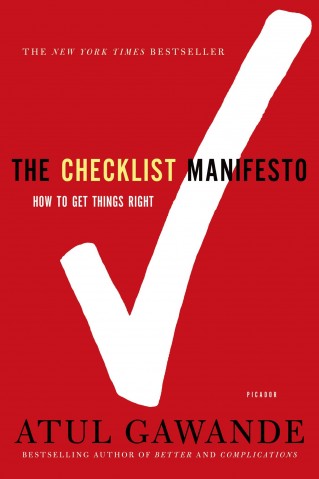
The Checklist Manifesto; Post 1
The Checklist Manifesto
By: Atul Gawande
Post 1
My fifth, and final book, has sadly arrived. By the time I finish reading this book, the end of our Literature Blog Project Reader's Workshop... thing... will arrive. I do not believe that I will plan on updating this blog nearly as frequently (though I may plan to start a separate blog, not focused on reading, later), but you are always welcome back to check for updates and such. And let's get down to the brass tacks...
So The Checklist Manifesto is written by Atul Gawande, who is both a writer and a surgeon. He starts off the book by talking about stories he had heard over time about medical emergencies whose most serious challenges could have been solved by being more observant, in other words, avoidable mistakes that were almost too costly. His experience as a surgeon, no doubt, will be a big contributor to the explanation of the checklist manifesto, as it is imperative that a doctor such as a surgeon be sure that all important procedures and steps are carried out.
I look forward to what kind of insights on checklists, organization, and the like are provided in this book. I'm not sure yet, but I am expecting a Malcolm Gladwell-like style in which the main idea of the book is laid out in sections each support by numerous studies, examples, etc.
Until next time,
Josh C.
By: Atul Gawande
Post 1
My fifth, and final book, has sadly arrived. By the time I finish reading this book, the end of our Literature Blog Project Reader's Workshop... thing... will arrive. I do not believe that I will plan on updating this blog nearly as frequently (though I may plan to start a separate blog, not focused on reading, later), but you are always welcome back to check for updates and such. And let's get down to the brass tacks...
So The Checklist Manifesto is written by Atul Gawande, who is both a writer and a surgeon. He starts off the book by talking about stories he had heard over time about medical emergencies whose most serious challenges could have been solved by being more observant, in other words, avoidable mistakes that were almost too costly. His experience as a surgeon, no doubt, will be a big contributor to the explanation of the checklist manifesto, as it is imperative that a doctor such as a surgeon be sure that all important procedures and steps are carried out.
I look forward to what kind of insights on checklists, organization, and the like are provided in this book. I'm not sure yet, but I am expecting a Malcolm Gladwell-like style in which the main idea of the book is laid out in sections each support by numerous studies, examples, etc.
Until next time,
Josh C.
Thursday, March 27, 2014
Life of Pi; Post 3
Life of Pi
By: Yann Martel
Post 3
Just like the movie, Life of Pi was truly something special. I had already seen the movie. I knew what to expect (The movie actually surprisingly true to the book, unlike some book-to-film adaptations). But I was still gripped by the plot, excited by Pi and Richard Parker's relationship, and satisfied by the ending all over again.
SPOILER ALERT
Since I last posted, all of the other animals on the life boat besides Richard Parker have died. The hyena was in fact killed by Richard Parker. As the days wore on, Pi made use of the lifeboat's supplies, including life vests and buoyant oars to make a raft so as to be separate from Richard Parker. He fished, witnessing many marine wonders, like whales, sharks, dorados (a type of fish which would turn rainbow and iridescent in its death throes), and flying fish. Gradually, as time wore on, and things like his life boat rations running out, his discovery of how to use solar stills to purify salt water, and the (eventual) destruction of his raft, Pi realizes that he must tame Richard Parker so that they can survive the ordeal (or at least so that Pi will be able to live on the life boat). Using the rocking of the boat, Richard Parker's seasickness, a whistle, and the supplying of food, Pi manages to tame Richard Parker, to an extent. Richard Parker recognizes him as the 'alpha' of the boat.
Two major events that Pi and Richard Parker experience are the meeting of another castaway and the discovery of an island. At one point in the story, Pi is overcome with the heat of the sun and fatigue, and becomes unable nourish himself, to the point where he becomes temporarily blinded. While blinded, he apparently meets another man (who has a French accent). They converse, and the other man claims to be blind as well. However, upon tethering their boats to each other, the other man, who is revealed to have lied about his blindness, attacks Pi, choking him. Pi, still delirious, accepts it as an embrace, and forgets to warn the man about Richard Parker. The man, who reveals his intentions to butcher and devour Pi for his own nourishment steps on the bottom of the boat and is subsequently devoured alive by Richard Parker. When Pi regains his eyesight after some brief nourishment through morsels of food that on the other man's boat and some rinsing with (sea)water, he finds the man's mangled half-eaten corpse. The other major event during Pi and Richard Parker's adventures include their landing on a strange isle. It is filled with vegetation and meerkats, and for the first time in a long time, Pi and Richard Parker are able to relax a little and enjoy the delicious algae and fresh water found on the isle. However, they discover later that the isle is more of a floating mass of carnivorous vegetation. At night, the ground and the freshwater ponds became highly acidic, digesting fish in the water and burning the soles of Pi's feet. Pi additionally found the remains of another human who must have stumbled upon the island: all that remained was a set of teeth. Pi and Richard Parker quickly left after that.
It was a short time later that they came upon land; the Mexican shores. Richard Parker flees into the forest, leaving Pi alone, even after all they'd been through together. Pi is rescued by a group of people who take him to the hospital, where he recovers. Two Japanese men from the company that the Tsimtsum sailed for come to interview Pi about the causes of the sinking of the ship, and what happened to him. They do not gain much information about the cause of the wreck, and initially they do not believe Pi's story with animals, so they request he tell the "truth." Pi responds with another story. This story metaphorically represents what happened, and also left out the seemingly supernatural events. The role of the zebra is replaced by a young sailor, the hyena by a vicious bloodthirsty cook, the orangutan by Pi's mother, and the tiger with Pi. The sailor's leg is broken, and after a prolonged period of time, he dies. The sailor is butchered, used for fishing, and eaten by the cook. Several days later, the cook attacks Pi for failing to catch a turtle, and Pi's mother hits the cook (the orangutan had originally fought back against the hyena by bopping it on the head). The cook turns on Pi's mother, who tells Pi to head towards a raft tied to the life boat. Pi's mother is then beheaded by the cook (the orangutan was beheaded by the hyena), who throws her head at Pi. Pi then kills the cook, just as Richard Parker killed the hyena. The Japanese men subsequently put the story with animals (the true story) on the official report.
So... a LOT happened in the second half of the book. More than can be merely summarized in a few short paragraphs.
I mentioned earlier that I thought religion would play a really big part in the book later... it didn't as much as I thought it would. It is touched upon a lot in the beginning, but the story ends up taking a much different focus by the end. I think probably the most interesting and prevalent dynamic and theme is the relationship between Pi and Richard Parker. At the beginning of their journey together, their relationship is rocky. But eventually, Pi gathers the courage to establish himself as 'alpha male' of the life boat, and Richard Parker (appears) to develop, at the very least, a grudging respect for him as leader. Their relationship continued to strengthen, even more so on the island, when Pi had Richard Parker perform tricks (jumping through a vine hoop), in an almost domesticated way. The real fascinating part was Richard Parker's ending of their partnership, by running off into the Mexican jungle without so much as a glance backwards. "In some such way, he would conclude our relationship. He did nothing of the sort... Then Richard Parker, companion of my torment, awful, fierce thing that kept me alive, moved forward and disappeared forever from my life" (Martel 284-285). I believe that though there was no physical indication, Richard Parker's decision to move on w a sign to Pi to not dwell on the past too much (but look to the future), and this advice was his farewell, conclusion, and goodbye.
Again, another great book has been completed. What book will come next?
Until next time,
Josh C.
By: Yann Martel
Post 3
Just like the movie, Life of Pi was truly something special. I had already seen the movie. I knew what to expect (The movie actually surprisingly true to the book, unlike some book-to-film adaptations). But I was still gripped by the plot, excited by Pi and Richard Parker's relationship, and satisfied by the ending all over again.
SPOILER ALERT
Since I last posted, all of the other animals on the life boat besides Richard Parker have died. The hyena was in fact killed by Richard Parker. As the days wore on, Pi made use of the lifeboat's supplies, including life vests and buoyant oars to make a raft so as to be separate from Richard Parker. He fished, witnessing many marine wonders, like whales, sharks, dorados (a type of fish which would turn rainbow and iridescent in its death throes), and flying fish. Gradually, as time wore on, and things like his life boat rations running out, his discovery of how to use solar stills to purify salt water, and the (eventual) destruction of his raft, Pi realizes that he must tame Richard Parker so that they can survive the ordeal (or at least so that Pi will be able to live on the life boat). Using the rocking of the boat, Richard Parker's seasickness, a whistle, and the supplying of food, Pi manages to tame Richard Parker, to an extent. Richard Parker recognizes him as the 'alpha' of the boat.
Two major events that Pi and Richard Parker experience are the meeting of another castaway and the discovery of an island. At one point in the story, Pi is overcome with the heat of the sun and fatigue, and becomes unable nourish himself, to the point where he becomes temporarily blinded. While blinded, he apparently meets another man (who has a French accent). They converse, and the other man claims to be blind as well. However, upon tethering their boats to each other, the other man, who is revealed to have lied about his blindness, attacks Pi, choking him. Pi, still delirious, accepts it as an embrace, and forgets to warn the man about Richard Parker. The man, who reveals his intentions to butcher and devour Pi for his own nourishment steps on the bottom of the boat and is subsequently devoured alive by Richard Parker. When Pi regains his eyesight after some brief nourishment through morsels of food that on the other man's boat and some rinsing with (sea)water, he finds the man's mangled half-eaten corpse. The other major event during Pi and Richard Parker's adventures include their landing on a strange isle. It is filled with vegetation and meerkats, and for the first time in a long time, Pi and Richard Parker are able to relax a little and enjoy the delicious algae and fresh water found on the isle. However, they discover later that the isle is more of a floating mass of carnivorous vegetation. At night, the ground and the freshwater ponds became highly acidic, digesting fish in the water and burning the soles of Pi's feet. Pi additionally found the remains of another human who must have stumbled upon the island: all that remained was a set of teeth. Pi and Richard Parker quickly left after that.
It was a short time later that they came upon land; the Mexican shores. Richard Parker flees into the forest, leaving Pi alone, even after all they'd been through together. Pi is rescued by a group of people who take him to the hospital, where he recovers. Two Japanese men from the company that the Tsimtsum sailed for come to interview Pi about the causes of the sinking of the ship, and what happened to him. They do not gain much information about the cause of the wreck, and initially they do not believe Pi's story with animals, so they request he tell the "truth." Pi responds with another story. This story metaphorically represents what happened, and also left out the seemingly supernatural events. The role of the zebra is replaced by a young sailor, the hyena by a vicious bloodthirsty cook, the orangutan by Pi's mother, and the tiger with Pi. The sailor's leg is broken, and after a prolonged period of time, he dies. The sailor is butchered, used for fishing, and eaten by the cook. Several days later, the cook attacks Pi for failing to catch a turtle, and Pi's mother hits the cook (the orangutan had originally fought back against the hyena by bopping it on the head). The cook turns on Pi's mother, who tells Pi to head towards a raft tied to the life boat. Pi's mother is then beheaded by the cook (the orangutan was beheaded by the hyena), who throws her head at Pi. Pi then kills the cook, just as Richard Parker killed the hyena. The Japanese men subsequently put the story with animals (the true story) on the official report.
So... a LOT happened in the second half of the book. More than can be merely summarized in a few short paragraphs.
I mentioned earlier that I thought religion would play a really big part in the book later... it didn't as much as I thought it would. It is touched upon a lot in the beginning, but the story ends up taking a much different focus by the end. I think probably the most interesting and prevalent dynamic and theme is the relationship between Pi and Richard Parker. At the beginning of their journey together, their relationship is rocky. But eventually, Pi gathers the courage to establish himself as 'alpha male' of the life boat, and Richard Parker (appears) to develop, at the very least, a grudging respect for him as leader. Their relationship continued to strengthen, even more so on the island, when Pi had Richard Parker perform tricks (jumping through a vine hoop), in an almost domesticated way. The real fascinating part was Richard Parker's ending of their partnership, by running off into the Mexican jungle without so much as a glance backwards. "In some such way, he would conclude our relationship. He did nothing of the sort... Then Richard Parker, companion of my torment, awful, fierce thing that kept me alive, moved forward and disappeared forever from my life" (Martel 284-285). I believe that though there was no physical indication, Richard Parker's decision to move on w a sign to Pi to not dwell on the past too much (but look to the future), and this advice was his farewell, conclusion, and goodbye.
Again, another great book has been completed. What book will come next?
Until next time,
Josh C.
Tuesday, March 25, 2014
Life of Pi; Post 2
Life of Pi
By: Yann Martel
Post 2
Hooray, I've reached a halfway point! Life of Pi is very entertaining. It keeps me enthralled, not so much with suspense, action, or adventure, but more the story premise itself.
SPOILER ALERT
A boy stranded on a lifeboat with a tiger, and a hyena, (and a now-deceased orangutan and zebra) in the middle of the Pacific Ocean. The whole concept is very interesting. So to recap, Pi's family has sold their zoo, and boarded a Japanese cargo ship (the Tsimtsum) headed for Canada. Pi has, since my last post, taken an interest in religion and the concept of God. He was born into the Hindu religion, but over the course of several chapters, also accepts and begins practicing Christianity and Islam. While his parents, brother, and various religious leaders are skeptical about his multiple faiths, Pi claims that he is merely trying to love God in as many ways as possible. So anyway, while on the Tsintsum in the middle of the Pacific Ocean, a massive storm hits and sinks the ship. The sole survivors are Pi, a zebra, an orangutan, a hyena, and a tiger named Richard Parker (The result of a mix up between the man who captured the tiger to send to the zoo's name, and the name the man gave the tiger). The zebra and orangutan have since been killed by the hyena, who is now being kept in check by the presence of Richard Parker.
A common theme that has been present in this book so far is the concept of religion, and God. Pi expresses his pleasure in being able to pursue multiple religions, and that his goal is "I just want to love God" (Martel 69). Additionally, earlier in the book (Author's Note), Martel is referred to Pi by a man, claiming Pi's story will "make you [Martel] believe in God" (Martel X). All of these religious elements in the early exposition of the beginning of the story set the stage for more themes about religion and God, which I do know are briefly touched upon in the movie.
As I mentioned in my last post, I do want to be pointing out the differences between the book and the movie, as I've seen so far. And so...
Plot elements included in the movie, but not the book:
- Pi attempts to feed Richard Parker, which causes Pi's father to show Ravi and Pi Richard Parker killing a goat (in the book, he shows it to them for no overt reason).
- Pi finds a girlfriend in the movie, but must leave her when he moves to Canada.
- Richard Parker immediately kills the hyena when the hyena kills the Orangutan (R.P. has not killed the hyena in the book yet)
Plot elements included in the book but not the movie:
- None so far
Until next time,
Josh C.
By: Yann Martel
Post 2
Hooray, I've reached a halfway point! Life of Pi is very entertaining. It keeps me enthralled, not so much with suspense, action, or adventure, but more the story premise itself.
SPOILER ALERT
A boy stranded on a lifeboat with a tiger, and a hyena, (and a now-deceased orangutan and zebra) in the middle of the Pacific Ocean. The whole concept is very interesting. So to recap, Pi's family has sold their zoo, and boarded a Japanese cargo ship (the Tsimtsum) headed for Canada. Pi has, since my last post, taken an interest in religion and the concept of God. He was born into the Hindu religion, but over the course of several chapters, also accepts and begins practicing Christianity and Islam. While his parents, brother, and various religious leaders are skeptical about his multiple faiths, Pi claims that he is merely trying to love God in as many ways as possible. So anyway, while on the Tsintsum in the middle of the Pacific Ocean, a massive storm hits and sinks the ship. The sole survivors are Pi, a zebra, an orangutan, a hyena, and a tiger named Richard Parker (The result of a mix up between the man who captured the tiger to send to the zoo's name, and the name the man gave the tiger). The zebra and orangutan have since been killed by the hyena, who is now being kept in check by the presence of Richard Parker.
A common theme that has been present in this book so far is the concept of religion, and God. Pi expresses his pleasure in being able to pursue multiple religions, and that his goal is "I just want to love God" (Martel 69). Additionally, earlier in the book (Author's Note), Martel is referred to Pi by a man, claiming Pi's story will "make you [Martel] believe in God" (Martel X). All of these religious elements in the early exposition of the beginning of the story set the stage for more themes about religion and God, which I do know are briefly touched upon in the movie.
As I mentioned in my last post, I do want to be pointing out the differences between the book and the movie, as I've seen so far. And so...
Plot elements included in the movie, but not the book:
- Pi attempts to feed Richard Parker, which causes Pi's father to show Ravi and Pi Richard Parker killing a goat (in the book, he shows it to them for no overt reason).
- Pi finds a girlfriend in the movie, but must leave her when he moves to Canada.
- Richard Parker immediately kills the hyena when the hyena kills the Orangutan (R.P. has not killed the hyena in the book yet)
Plot elements included in the book but not the movie:
- None so far
Until next time,
Josh C.
Subscribe to:
Comments (Atom)